Proficiency levels are the fundamental understanding of how we can effectively communicate in our target languages. Frequently, I get asked about this and thought I would address it with some reference points as well as a few recommendations.
Let’s simply get into this with the most commonly recognized system, and the one I’ll typically use for CVs or quick reference.
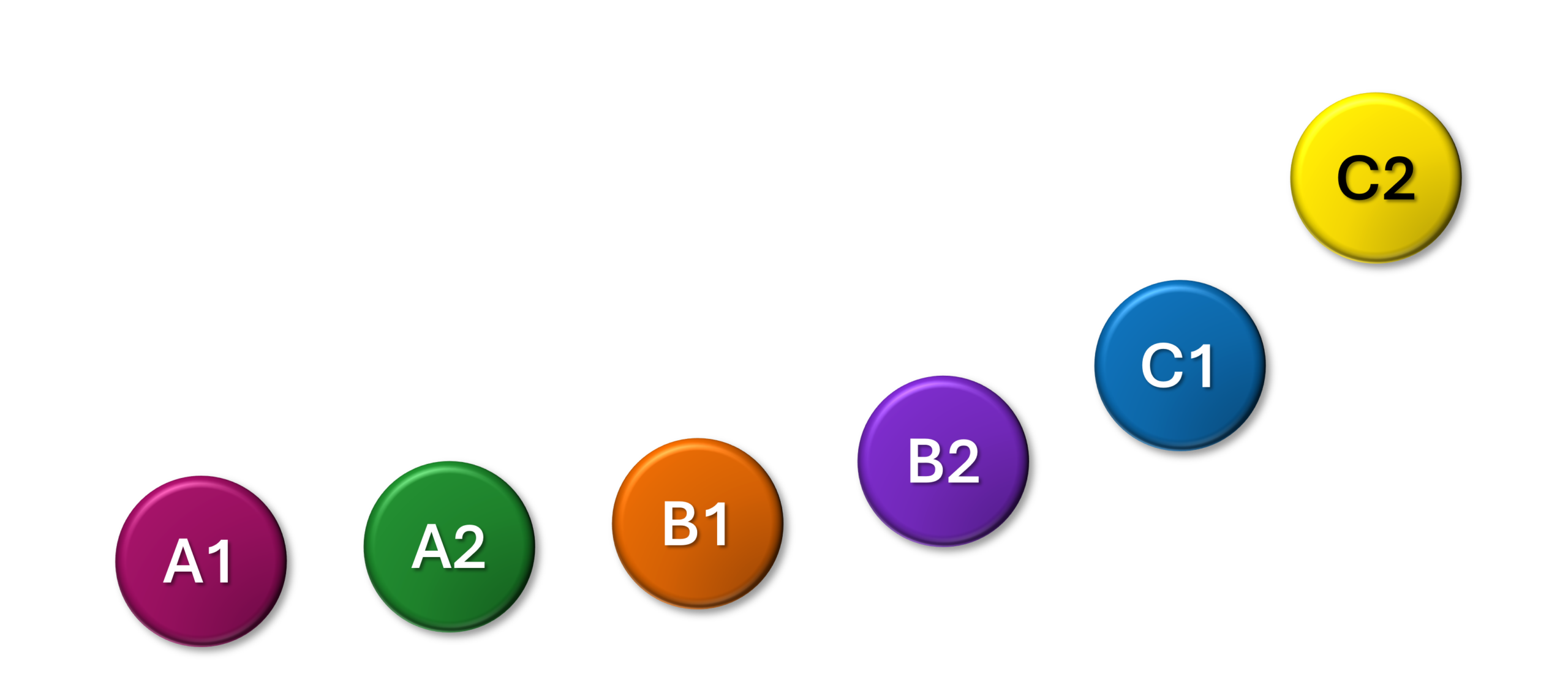
CEFR (Common European Framework of Reference for Languages). It’s not surprising this would be the first listed since it’s the most widely recognized and actively used from employment, education, and migration boards globally. Here’s a look at how it’s laid out:
A1 – Beginner
- Can understand and use everyday expressions and very basic phrases.
- Can introduce themselves and others, and ask/answer questions about personal details.
- Can interact in a simple way if the other person talks slowly and clearly.
Example skills:
- “My name is Anna. I am from Spain.”
- “Where is the bathroom?”
A2 – Elementary
- Can understand sentences and frequently used expressions related to areas of immediate relevance (e.g., shopping, family, work).
- Can communicate in simple and routine tasks requiring a direct exchange of information.
Example skills:
- “I would like a coffee, please.”
- “I live in a small apartment near the park.”
B1 – Intermediate
- Can understand the main points of clear standard input on familiar matters.
- Can deal with most situations likely to arise while traveling.
- Can produce simple connected text on familiar topics.
Example skills:
- “I’ve been working here for three years.”
- “I think the recipe is delicious, but I still want to change a few things.”
B2 – Upper Intermediate
- Can understand the main ideas of complex texts on both concrete and abstract topics.
- Can interact with some degree of fluency and spontaneity with native speakers.
- Can produce clear, detailed text on a wide range of subjects.
Example skills:
- “He was really tired, but decided to go to the concert anyway.”
- “There are several reasons why this policy will not be effective in the long term.”
C1 – Advanced
- Can understand a wide range of demanding, longer texts, and recognize implicit meaning.
- Can express themselves fluently and spontaneously without much obvious searching for expressions.
- Can use language flexibly and effectively for social, academic, and professional purposes.
Example skills:
- “While I appreciate your perspective, I feel that the piece suggests a different ending based on the gentler harmonies in the previous scene’s music.
- “The novel’s underlying themes reflect a broader commentary on societal expectations seen by an iconic hero of the era.”
C2 – Fluency
- Can understand practically everything heard or read with ease.
- Can summarize information from spoken and written sources, recalling and presenting arguments or other accounts in a coherent presentation.
- Can express themselves spontaneously, fluently and precisely, even in more complex situations.
Example skills:
- “Despite the nuanced implications of the policy, its implementation revealed a fundamental misalignment with the community’s needs.”
- “Her argument was compelling, not only because of its logical structure but also due to the rhetorical finesse with which it was delivered to the council.”
Quick Reference:
| Level | Name | Description |
| A1 | Beginner | Basic phrases, introductions, simple interactions |
| A2 | Elementary | Everyday tasks, simple conversations |
| B1 | Intermediate | Routine interactions, basic opinions |
| B2 | Upper Intermediate | Fluent conversations, abstract topics |
| C1 | Advanced | Complex ideas, nuanced expression |
| C2 | Mastery/Fluency | Near-native fluency, precision, and comprehension |
ILR (Interagency Language Roundtable Scale)
This is a pragmatic 0-5 scale which is typically used for US government, military use, though it’s appropriate, in my opinion, to use such a scale, since it’s applicable to pretty much everyone regardless of usage context or national origin.
0: No proficiency
1: Elementary
2: Limited working proficiency
3: Professional working proficiency
4: Full professional proficiency
5: Native or bilingual proficiency
These systems are the most commonly used internationally nowadays, though this is a bit broad and can be more specific for individual languages that have characteristics that can be isolated into their own frameworks for university use and standardized testing. National exams and university-specific types of systems would require their own overviews to do them justice and will be linked with their associated languages in my site map if I decide to go into these more in detail at some point, but are typically based on listening, reading, writing, speaking, etc. A few examples are Mandarin HSK (汉语水平考试), Hebrew Alef–Heh, and Japanese JLPT.
With this, you should have a pretty respectful understanding of how to measure proficiency easily, honestly, using the systems recognized around the globe as a guide in order to achieve realistic goals. Be kind to yourself, your pupils, have patience, and just have fun! Do things you love in your target languages; It’s important to do things you already do in your daily life or that give you some endorphins and keep you stimulated when needed, and even relaxed when needed. If you want to speak Thai and workout, count your reps and learn some important gym vocab. If you like cooking, follow some podcasts, watch videos or TV shows about cooking in Thai, listen to music, practice calligraphy, find others that have your passions and things will come together much more naturally – enjoy the process!
